heat engines (internal combustion engines and steam engines) and electric engines used in automotive vehicles. Most automotive engines are piston (reciprocating) internal combustion engines. Automotive engines are divided into four-cycle and two-cycle engines according to the working process and are divided by the method of fuel ignition into spark plug ignition engines (also known as carburetor engines or gasoline engines) and diesel engines, which are self-ignition engines using high-temperature air compressed within the engine cylinders. The fuel mixture of vaporized gasoline and air, blended in the carburetor, is admitted to the cylinders of carburetor piston engines. Piston engines without carburetors also exist; these are equipped with a device for direct injection of fuel into the intake manifold or into the engine cylinder.
The operating cycle of these engines is the same as that of carburetor engines. In diesel engines, diesel fuel is sprayed through the nozzle of a high-pressure pump directly into the cylinders, where it is mixed with air. Automotive engines are distinguished by the number and placement of the cylinders (in-line engines, V-engines, and so on), by the location of the valves (in the cylinder head or in the cylinder block), by the cylinder capacity, by the motor cooling system (liquid or air), by function, and so on. Four-cycle overhead valve liquid-cooled carburetor-type piston engines are used in modern automobiles, as well as in small and medium trucks. Diesels, which burn a cheaper fuel than gasoline and offer advantages over carburetor type engines in fuel economy and length of service, are used mainly for the propulsion of heavy trucks and large buses. Gasoline motors are superior in ease of design and low initial cost, power per liter of displacement, starting qualities, and control of exhaust smoke, but modern high-speed diesel

engines come close to carburetor engines in such important performance characteristics as specific mass (kg/kW or kg/hp), compactness, and noise-free operation. With these advances, and thanks to increases in power per liter of displacement, diesel engines have begun to find applications within the past decade in lightweight trucks and even in passenger automobiles.
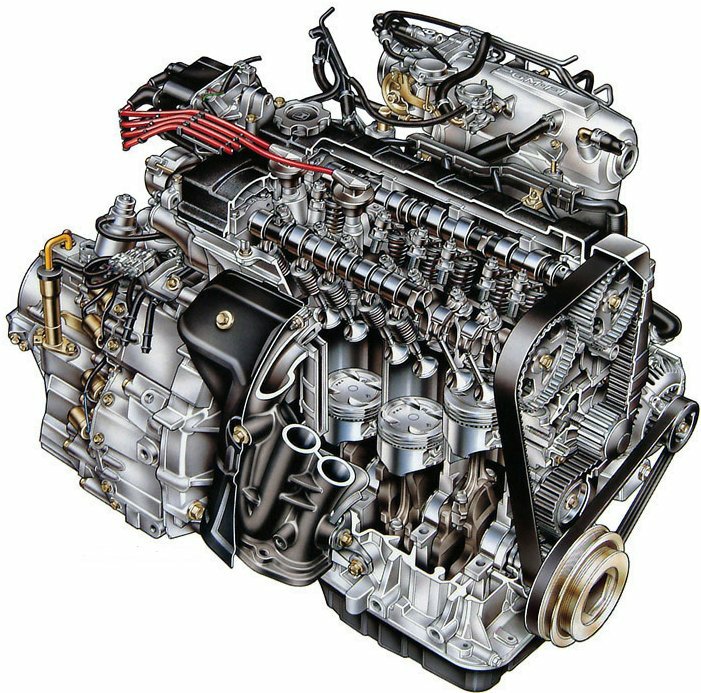
Modern four-cycle piston engines (see Figures 1 and 2) consist of a cylinder block usually made integrally with the crankcase, the cylinder head, pistons with sealing rings and oil-control piston rings, connecting rod, crankshaft, flywheel, camshaft, spring-loaded intake and exhaust valves, valve train parts (rocker arm, valve lifter), the drive connecting the crankshaft and camshaft, spark plugs or fuel nozzle, and so on. These engines are equipped with a radiator and fan for the cooling system. They have pumps for forced circulation of lubricant oil and cooling fluid and for bringing fuel from the fuel tank, as well as fuel filters, oil filters, and air cleaners, a starter or cranking motor, ducts for air, gas, fuel, oil, and cooling fluid, and automatic control devices controlling the frequency of rotation of the crankshaft and the temperature of the cooling fluid and fuel mixture.
The power of modern (1968) carburetor piston engines for automobiles ranges from 15 to 310 kilowatts (kW) (20–425 horsepower [hp]), their cylinder displacements from 0.35 to 7.6 liters, compression ratios from 7:1 to 11:1, maximum frequencies of crankshaft rotation from 4,000 to 6,000 rpm, power per liter of displacement from 22 to 50 kW/liter (30 to 70 hp/liter), specific masses from 1.1 to 4 kg/kW (0.8 to 3 kg/hp), and minimum specific fuel rates up to 270 g/ (kW ξ hr) [200 g/(hp ξ hr)]; service life to the first major overhaul corresponds to a distance of 75,000–150,000 km or more. In sports and racing piston engines, the crankshaft rotation frequency attains 10,000–12,000 rpm, while the power per liter of displacement sometimes exceeds 150 kW/liter (200 hp/liter). In carburetor piston engines used in heavy-duty trucks, the power is not greater than 220 kW (300 hp); the cylinder displacement ranges from 1.5 to 9.5 liters, the compression ratio from 6.5:1 to 8.5:1, and the maximum frequency of crankshaft rotation 2,500 to 4,000 rpm. Diesel reciprocating engines generate power of 30 to 620 kW (40–850 hp) and feature cylinder displacements of 1.5 to 40 liters, compression ratios of 15:1 to 24:1, maximum frequencies of crankshaft rotation from 2,000 to 5,000 rpm, power per liter of displacement from 11 to 23 kW/liter (15–35 hp/liter), specific masses from 3.4 to 6.8 kg/kW (2.5–5 kg/hp), and minimum specific fuel rates from 205 to 210 g/(kW × hr) [150–155 g/(hp × hr)]; service life to the first major overhaul corresponds to a distance of 150,000 to 300,000 km.
 Automotive Engineering